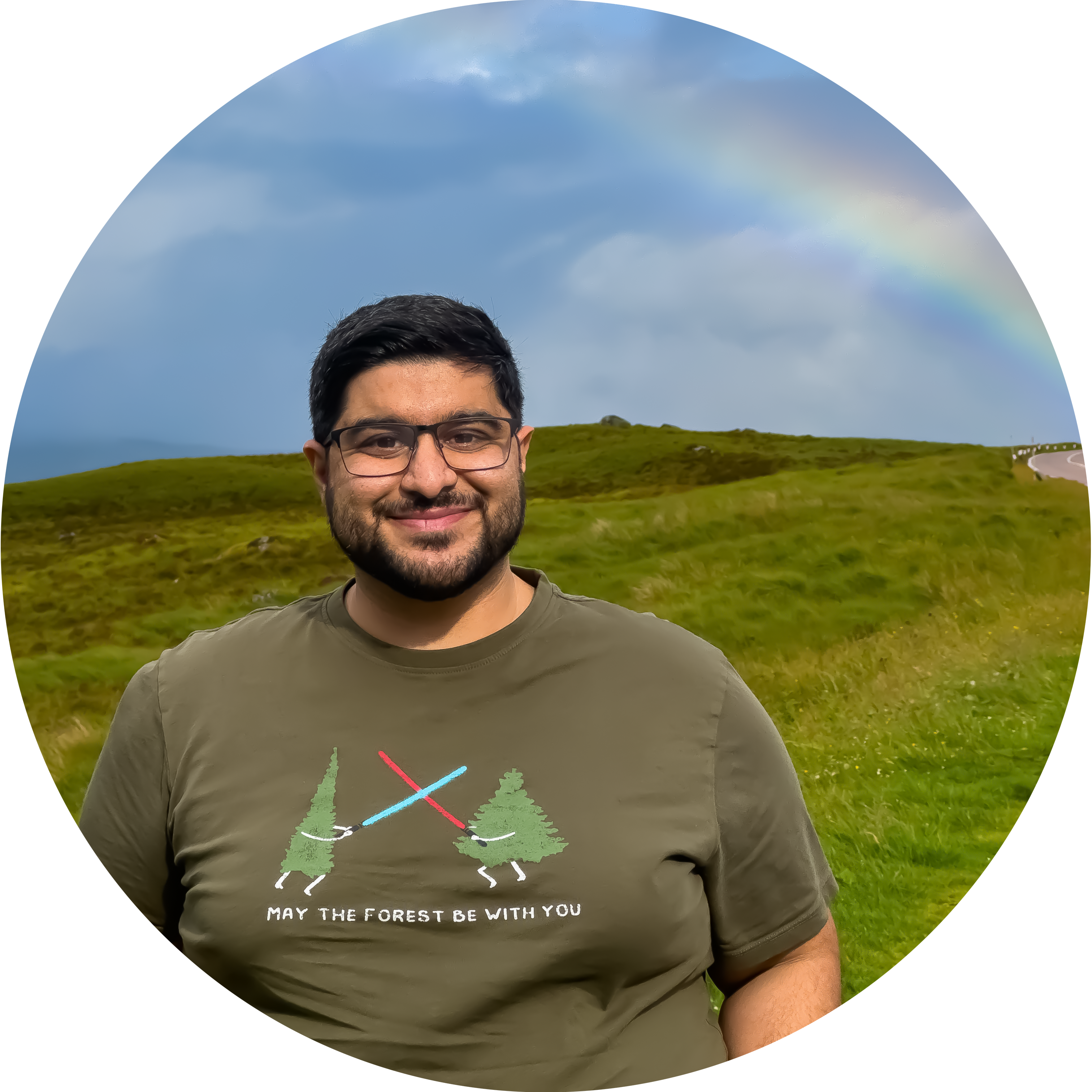
I am a PhD student in astronomy at the University of Sussex. My research focuses on large-scale structure cosmology, with an emphasis on testing and validating galaxy survey catalogues using galaxy clustering. I work primarily on the Cosmology Redshift Survey (CRS) and the Wide Area VISTA Extragalactic Survey (WAVES), both conducted with the 4-metre Multi-Object Spectroscopic Telescope (4MOST).
A central theme of my work is understanding when a galaxy catalogue can be trusted for precision cosmology. In modern wide-area surveys, target selection, imaging depth, extinction, masking, and stellar contamination can all imprint spatial structure that mimics or distorts true clustering. I address this by using two-point statistics, particularly the angular correlation function <p>\(w(\theta)\)<p>, as a diagnostic tool to assess catalogue quality, quantify systematic effects, and inform survey design and analysis choices.
A major part of my PhD involves validating galaxy target selections for 4MOST CRS, including Bright Galaxy and Luminous Red Galaxy samples selected from wide-field imaging. I test alternative selection and masking strategies, assess angular uniformity, and use clustering-based diagnostics and redshift reconstruction techniques to evaluate sample robustness. In parallel, I apply similar clustering-based validation methods to WAVES, testing photometric systematics, stellar contamination, and the impact of different magnitude and colour selections on large-scale clustering.
Beyond galaxy samples, I also work on quasar target selection for 4MOST CRS and for the planned Widefield Spectroscopic Telescope (WST), with a focus on selecting samples suitable for large-scale structure and high-redshift applications.
Methodologically, my work centres on two-point statistics in angular and projected space, Limber scaling tests, covariance estimation, and the development of reproducible, survey-agnostic Python pipelines. These tools are designed to test how observational and selection effects propagate into clustering measurements and uncertainties, and to support robust cosmological analyses.
I am a permanent member of the 4MOST Science Team, contributing to survey preparation, Commissioning, and Science Verification, with planned on-site Science Verification work at Paranal Observatory. I am also a member of the Euclid Consortium and LSST-DESC, and I am interested in applying my experience in survey systematics and photometric clustering to Euclid and LSST.
Alongside my research, I am actively involved in science communication and outreach. I serve as a Science Communication co-lead for 4MOST, coordinating outreach activities, developing survey-related communication materials, and supporting engagement with the broader astronomical community.
I also regularly contribute to public talks, workshops, and outreach events, and work with local astronomical societies to communicate survey science and observational cosmology to wider audiences. I am particularly interested in making large survey projects accessible and transparent, and in connecting technical survey work with public-facing narratives about how we map and understand the Universe.
An up-to-date list of my papers is available on the Publications page.